
Intelligent Robots Fuel the Flexible Manufacturing Upgrade of Daily-use Glass Industry
The “Robot Replacement” drive is sweeping across all industries, and behind small glass bottles lies a booming blue-ocean market for smart manufacturing.
As the world’s largest producer and consumer of glass products, China boasts daily-use glass goods closely integrated with daily life, covering food & beverage packaging, cosmetics, drinking utensils, pharmaceutical packaging materials, lamps, decorative accessories and small home appliances. Statistics from China Packaging Federation and China Daily-use Glass Association show that in 2023, China housed over 1,000 industrial-scale daily-use glass manufacturers, with the annual output of finished daily-use glass products and glass packaging containers hitting 24.8227 million tonnes and the overall market size exceeding RMB 180 billion.
Standardised glass bottles and tumblers dominate most market share of the sector. Nonetheless, rising living standards and shifting consumer demographics have spawned growing market demand for diversified, personalised and aesthetically refined glass products for food, beverage, cosmetic and pharmaceutical sectors. Despite a large number of domestic manufacturers, the industry remains highly fragmented with low penetration of intelligent manufacturing equipment, leaving a noticeable gap against leading international peers in overall technical maturity, intelligentisation level and production efficiency.
Mid-to-high-end daily-use glass items entail complicated manufacturing and weak underlying technologies. In the past, elaborately shaped premium glassware and special-shaped bottles relied heavily on manual labour or semi-mechanised production, plagued by harsh high-temperature working conditions, frequent product defects and inconsistent dimension & volume, resulting in tough production constraints and low finished product yields.
Driven by breakthroughs in artificial intelligence, cloud computing, robotics, IoT and digital twin technologies, global manufacturing is undergoing an automation and intelligent transformation. The daily-use glass sector stands at a pivotal upgrading juncture; developing new productive forces to lift labour productivity and realise high-quality, small-batch and multi-spec flexible manufacturing for mid-to-high-end glass commodities has become an urgent priority.
Multiple innovative technical achievements have emerged within the industry, with leading enterprises mastering previously bottlenecked intelligent manufacturing technologies including robotics, precision sensing, complex production system development and intelligent information processing.
Improving domestic industrial robot supply chains and localised substitution are reshaping the landscape of daily-use glass production. Glass production features volatile working conditions and intricate processing mechanisms from raw material preparation to forming, imposing stringent requirements on robotic stability, deployment simplicity, high-temperature resistance and operational tact time.
Customised for on-site production requirements, mainstream robots deployed across daily-use glass production cover parallel robots, gantry robots, SCARA robots and 4/6-axis articulated robots. They are widely applied across hot-end, cold-end and deep-processing workflows: raw material batching & bag breaking, kiln inspection & hot repair, mould oil coating, glass feeding & forming manipulation, in-furnace sorting, bottle loading/unloading, surface spraying, screen printing, case packing, palletising and warehouse logistics.
Conventional glass production lines require uninterrupted human attendance once commissioned. Industrial robots can operate round-the-clock to replace manual work involving repetitive tasks under extreme high-temperature, greasy and noisy environments. Combined with machine vision for inspection, positioning and identification, robots enable full-process quality control from upstream production, cutting human-induced breakage and defects while shortening product delivery lead times.
Though daily-use glass production robotics remains in the early development phase with ongoing iterations required for core technologies and applicable processing techniques, its intelligent evolution is revolutionising global glass fabrication, streamlining the production of premium custom glassware and catering to diversified modern consumer demands.
Daily-use Glass Robotics: An Untapped Blue-Ocean Application Market
According to GGII (Gaogong Robot Industry Institute), China’s industrial robot shipments reached 304,000 units in 2024, with automotive, 3C electronics and new energy sectors accounting for over 70% of total application volume.
Daily-use glass represents an emerging downstream niche for industrial robots. Spurred by strong intelligent & flexible upgrading demand from countless domestic and overseas glass manufacturers, especially food, beverage, cosmetic and pharmaceutical packaging producers, the segment has evolved into a fast-growing application hotspot for global robotics suppliers.
GGII industry research identifies roughly 20 robot variants applicable across full glass production chains spanning batching, forming, annealing, deep processing and warehousing to automate bag splitting, raw material handling, bottle loading/unloading, sorting, spraying, printing, capping, palletising and cargo conveyance.
Full-line robot integration (fewer than 20 units per production line) can replace around 67 frontline workers; each single robot substitutes 3 to 4 operators on average. A typical glass factory equipped with 2 kilns and 8 production lines can cut around 280 manual positions after full intelligent retrofitting.
Per IFR (International Federation of Robotics) 2023 statistics, China’s installed industrial robot stock stood at 1.755 million units, translating to over 15% overall manufacturing penetration, while penetration within food, beverage and cosmetic packaging stays below 3%, unlocking massive upside potential.
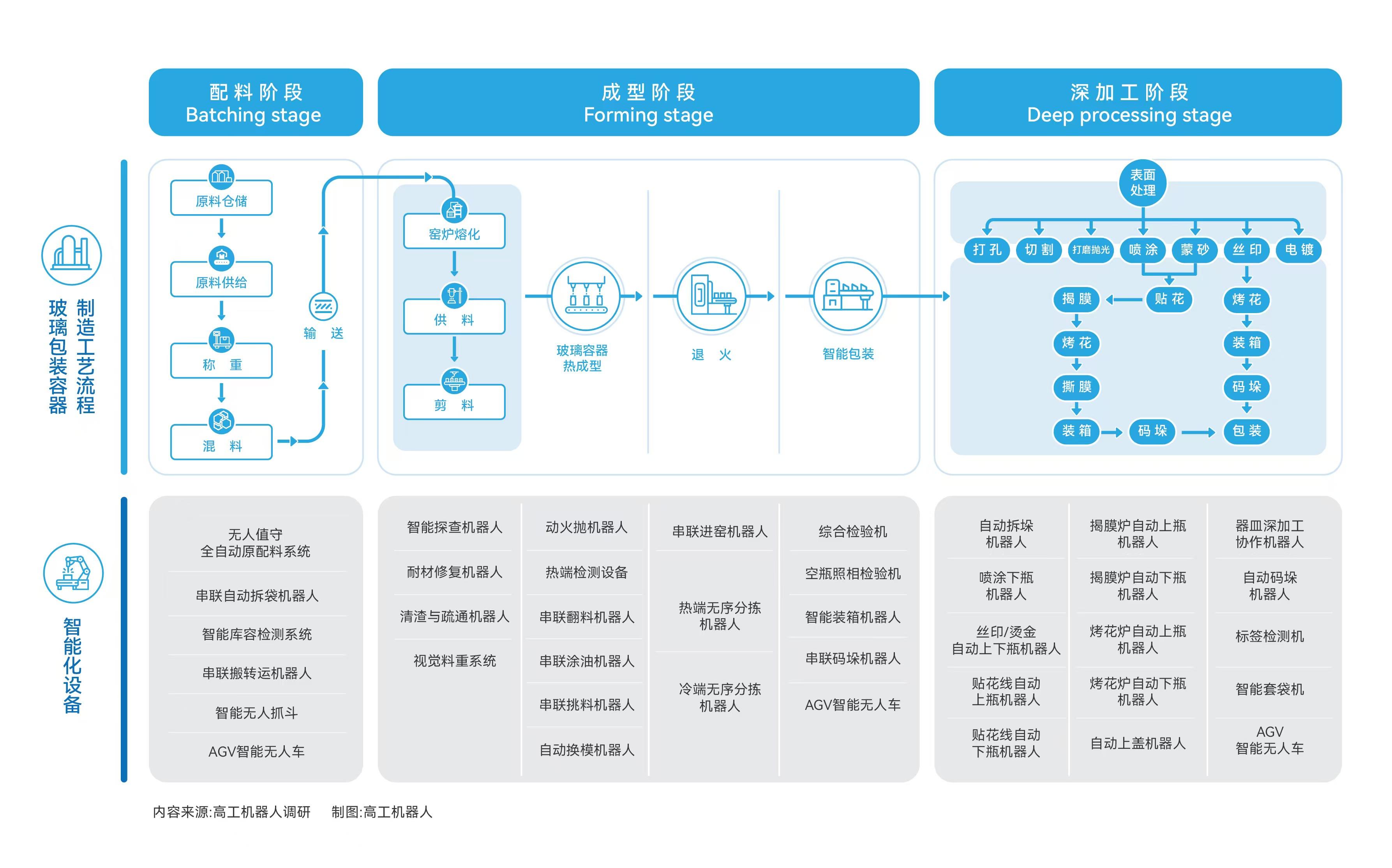
Glass Packaging Container Production Process & Intelligent Robot Equipment Diagrams
With more than 1,000 industrial-scale daily-use glass enterprises nationwide in 2023, GGII’s industrial calculation pins the sector’s robot market size at RMB 780 million and domestic robot demand at approximately 4,000 units that year. Driven by rising robotic penetration and accelerating intelligent production line renovation, the domestic daily-use glass robot market is projected to hit RMB 1.985 billion by 2028, alongside a global market valuation of RMB 141.6 billion.
Dozens of purpose-built glass production robots have been commercialised and field-deployed, yet high technical barriers, scattered downstream clients and low market penetration restrain widespread adoption. Most mainstream robotics integrators have stayed clear of this niche, with domestic glass equipment vendors dominating product development and the whole market still in infancy.
Current robotic products mostly focus on cold-end standalone processes such as loading, unloading and palletising; only a handful of suppliers deliver full-process solutions covering hot-end forming, intermediate processing and post-production logistics.
Key market players include: Hubei Chuda Intelligence, which develops over ten robot models for raw material turning, random sorting, spray-coating bottle handling and decorating furnace loading/unloading to cover extensive working procedures; Shanghai Shunzhang with dedicated feeding and glassware handling robots; Bucher Emhart Glass (Switzerland) and HEYE (Germany), Shandong Sanjiang Intelligence specialising in forming-stage automatic mould oil applicators; MSK (Germany), All Glass (Italy), Hangzhou Yongchuang Intelligence and Jiangsu Stake focusing on cold-end palletising robots.
By revenue and shipment volume, Chuda Intelligence stands as the domestic sector leader with a comprehensive portfolio of customised intelligent robots for glass production lines. Robotics deliver distinctive advantages in boosting product consistency, lifting productivity, withstanding extreme heat and enabling mixed-model flexible production. At the bottle forming stage, hot glass turning robots replace labour-intensive high-temperature manipulation of molten glass preforms to deliver uniform rimless glass container production and eliminate strenuous manual work under scorching ambient conditions. Automatic oil-coating robots execute precise intermittent mould spraying, replacing roughly 700 manual coating operations per worker across an 8-hour shift, cutting coating consumption, minimising defective output, reducing residual grease waste and extending mould service life. For instance, Sanjin Glass (equipped with Emhart technology) upgraded three production lines from nine full-time manual oilers to fully automatic robotic coating.
Hot-end gripper robots must endure continuous operating temperatures between 200℃ and 300℃, demanding bespoke structural design, high-temperature resistant composite materials and superior mechanical strength. Shanghai Shunzhang leverages ABB-based robotic feeding systems to extract equal-weight molten glass directly from melting furnaces. High-temperature random sorting robots from Chuda Intelligence, paired with proprietary machine vision, complete mixed-container classification at 200℃–300℃ annealing furnace exits to replace dangerous manual sorting work.
For deep-processing decorating procedures, dedicated furnace loading/unloading robots achieve fully automatic accurate grabbing, placement and capping for decorated glass products. On cold-end packaging lines, vision-guided palletising robots execute sophisticated high-speed automated stacking, case packing and inbound/outbound transportation tasks.
Per GGII data, loading/unloading and palletising applications account for over 60% of China’s total industrial robot deployment in 2023, securing solid market acceptance and growth space for corresponding glass-segment robotic solutions.
Technical Breakthroughs: From Single-Station Automation to Full-Scale Smart Factories
Urgent demand for intelligent transformation and mid-to-high-end product upgrading coexists with the sector’s nascent robotics development stage, requiring persistent efforts on market popularisation, product optimisation, customised solution development and core technical barrier breakthroughs.
Four core technical benchmarks define qualified glass-dedicated industrial robots:
- High-temperature resistance: Hot-end robot bodies and end-effectors need stable continuous operation under 200℃~300℃ with high ingress protection, compact footprint for confined installation and strict controls on self-weight vs rated payload via specialised heatproof materials.
- Precise cycle-time synchronisation: High-speed motion control and cross-equipment coordination to align robotic tact time with host glass forming machinery across feeding, sorting and spraying workflows.
- Robust machine vision algorithm: Optimised visual algorithms to offset interferences from variable bottle dimensions, colour discrepancies, fluctuating ambient illumination and height deviation during mixed-model flexible production.
- Cross-process compatibility: In-depth industry process know-how to realise seamless communication and coordinated operation with disparate automation equipment and satisfy bespoke factory requirements with long-term stable uptime.
Long-term industry evolution follows a clear path: from discrete single-process automation to full-line intelligent control, full-process inline quality inspection and eventually data-driven, visualised smart factory management. Ongoing deep integration between robotics and machine vision will drive precision improvement, unlock more “manpower replacement” scenarios and lift overall production capacity. As a front-runner, Chuda Intelligence advances next-gen customised robots, high-speed hybrid manipulators and intelligent visual inspection systems to support ≥6,000-unit hourly bottle handling, depalletising and palletising, spearheading full-industry intelligent advancement.
Beyond daily-use glass manufacturing, core underlying technologies including robotic motion control and visual inspection feature excellent cross-industry migration value, applicable to automated handling, packaging and quality testing across food processing, 3C electronics and automotive component production.
Empowered by continuous robotic technology iteration, solution providers focusing on core robotic R&D and flexible manufacturing expertise will push industrial transformation from isolated automated stations toward full-process smart factories across all verticals. The intelligent transformation of China’s daily-use glass manufacturing is well underway despite challenges ahead.
Source: Li Zexin, Gaogong Robot