
Author: Weng Jianzhong, Expert of China Packaging Federation / China Daily Glass Association
As known to industry insiders, the Owens vacuum suction bottle-making machine developed around 1905 was gradually phased out by gob-fed bottle forming machines by 1915, which later evolved into two distinct mainstream technical routes.
The first route was represented by the Lynch rotary bottle making machines manufactured by the Lynch Company of the United States from the 1920s to the 1960s, alongside Belgian-made large rotary machines including Model M8, R7 and S10 Rotomatic. These machines feature multiple forming units mounted on a rotating turntable; a complete bottle forming cycle is finished in one full turntable rotation, with blank moulds travelling underneath the feed orifice to receive molten glass gobs. Their prominent strengths lie in prolonged blank and final mould cooling/forming duration, yielding superior finished bottle quality and high yield rate. However, the series-connected structural layout brings obvious drawbacks: maintenance on a single unit requires full production line shutdown, resulting in poor fault isolation and high maintenance expenses.
The second route refers to the Individual & Section (I.S.) linear bottle forming machine invented in 1924, commonly shortened as IS machine, named after the initials of its two inventors. While sharing identical core forming principles with large rotary machines, all working units of IS machines are fixed and arranged side-by-side instead of rotating; rotating scoop feeders deliver glass gobs to stationary blank moulds separately. Its core merit is independent operation of parallel units with effective fault isolation without halting the whole line. Adopting a one-blank-mould-to-one-finish-mould structure, the IS machine delivers outstanding productivity for simple regular containers such as beer bottles, soda bottles and condiment bottles where blank and finish forming times are closely matched. Nevertheless, productivity drops drastically when producing mid-to-high-end bottles requiring extended finish setting time, as subsequent production cycles cannot start until prior containers are fully shaped, limiting production flexibility for diversified premium glassware.
Since China’s reform and opening-up, rising living standards have fueled robust market demand for glass containers across food, alcoholic beverage, soft drink, cosmetic, personal care, pharmaceutical and chemical sectors, spurring massive construction of domestic glass bottle production lines. Surging bulk orders for beer, beverage and sauce bottles fueled rapid expansion of IS machine manufacturers worldwide and domestically, including EMHART, BOTTERO, HEYE, BDF, Sanjin and Jiafeng.
At the start of the 21st century, newly upgraded rotary bottle making machines emerged after technical upgrades, integrating the high forming quality and high yield advantages of conventional large rotary equipment and the independent, fault-tolerant parallel layout merits of IS machines via innovative forming techniques and servo-controlled finish indexing. Currently, modern rotary bottle machines have become core mainstream equipment for glass container manufacturing, with ongoing R&D focused on higher productivity, flexible multi-variety production, as well as energy conservation and emission reduction. From the perspective of technical integration and iteration, this paper reviews the evolution history of rotary bottle making equipment, analyzes its core competitive edges and discusses its intelligent and eco-friendly development trends matching future industry demands.
Development History of Rotary Bottle Making Machines in China
In autumn 1936, Shanghai Jinghua Glass Works imported a 6-mould Lynch rotary bottle machine, marking China’s first adoption of automated continuous mass production for beer bottles. In 1958, Shanghai Tobacco Machinery Factory reverse-engineered and localized production of Lynch rotary equipment based on field measurement drawings by Shanghai Electromechanical Design Institute. In April 1984, Model BLZ10 rotary bottle machine developed by Weifang No.1 Light Industry Machinery Factory (now Weifang Xinchengda Machinery Co., Ltd.) passed official appraisal and was put into industrial service, dominating China’s domestic glass bottle manufacturing from the early 1960s to mid-1980s.
In 2005, Hubei Chuda Intelligent Equipment Co., Ltd. launched China’s first new-generation optimized rotary bottle making machine, ushering in a revival for rotary forming technology. Through successive structural upgrades and technical iterations, the firm has developed a full mature product portfolio with complete mass-production and independent new-product R&D capacity:
- 2005: DK-4A CNC bottle machine: Single-chip microcomputer control, cylinder-driven finish turret indexing and synchronous linkage for multiple units.
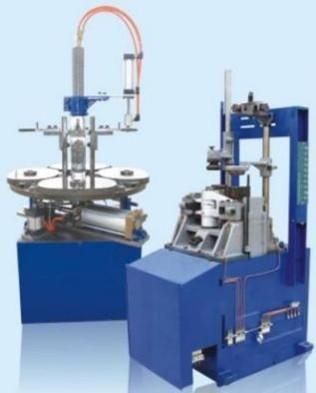
- 2010: 6S/7S servo bottle machine: Servo-driven finish turntable positioning, manual/automatic finish mould opening for semi-automatic production.
- 2011: LD-8S fully automatic rotary machine: Servo gob distribution + servo neck mould flipping, supporting up to four fully-automatic production units.
- 2014: H9S rotary machine: PLC control, automatic dual finish mould opening, available for single/double gob production with maximum six units.
- 2016: H9S8 model: Supports single/double gob forming with up to eight production units.
- 2017: LD-8SH high-precision CNC rotary machine: High-response high-precision servo system plus upgraded four-finish rotary cooling function.
- 2018: Synchronized positive-blow H9S series: Dual synchronized positive blowing technology improves both forming quality and line speed.
- 2021: Full bus-controlled rotary machine series: Full digitalized and intelligent whole-process parameter management via fieldbus technology.
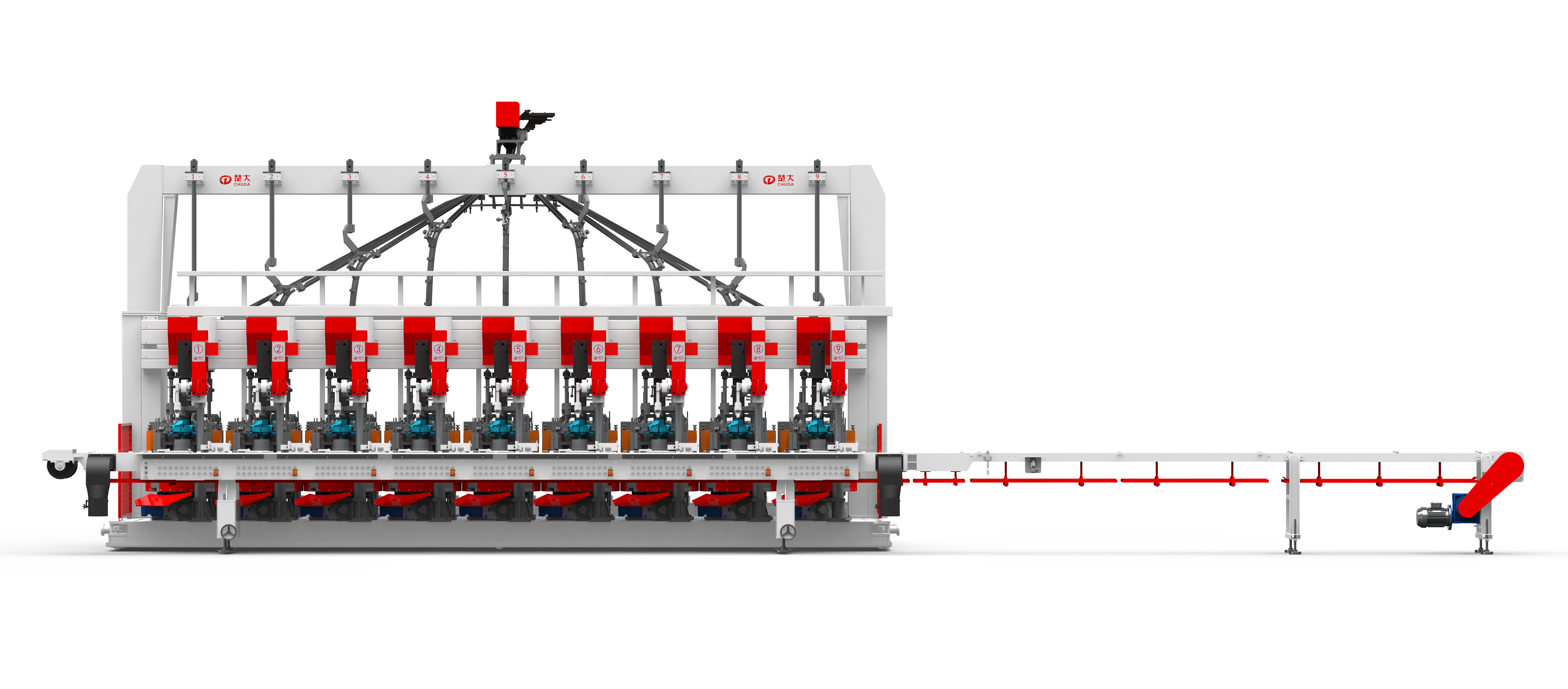
- 2023: H9S9 rotary machine: Lightweight finish structure enabling synchronous high-speed operation for nine units; H8S6 model with compact small turret design for up to six fully-automatic parallel units.
(To be continued)
References
- Zhao M. The History of China’s First Lynch Bottle Forming Machine[J]. Glass & Enamel & Spectacles, 2020(3).
- Yang Wenfeng. Brief History of Mechanized Glass Container Production.
- Official website of Hubei Chuda Intelligent Equipment Co., Ltd.: www.chuda.cn