Glass is globally recognized as the top sustainable packaging material, thanks to its infinite recyclability, non-toxic safe properties and durable physical performance. Yet this "green material" comes with a heavy carbon footprint: high-temperature glass melting generates around 0.3% of global anthropogenic CO₂ emissions.
On the other hand, automation, digitalization and AI are reshaping manufacturing worldwide. The recently concluded GLASSMAN ITALY 2026 raised the core industry question: Can decarbonization and digitalization revitalize the glass sector?
Growth persists, yet growth drivers have shifted
According to Glass Manufacturing Market Size & Research 2026–2050 by professional glass industry researcher Research Nester, global glass manufacturing market data is as follows:
- 2025 market size: ~USD 192.99 billion
- 2026 market size: to exceed USD 202.37 billion
- 2035 forecast: to surpass USD 326.54 billion
- 2026–2035 CAGR: ~5.4%
Regionally, the Asia-Pacific is expected to account for roughly 40% of global demand, followed by North America. Key growth catalysts include urbanization, expansion of automotive and new energy sectors, plus rising preference for recyclable packaging in food, beverage and pharmaceutical industries.
Notably, while market growth continues, its underlying drivers have transformed. Growth rates for traditional bulk segments such as architectural glass are slowing, whereas container glass, premium packaging, pharmaceutical and new energy glass have emerged as new growth engines. The industry is shifting from volume-driven expansion to structure & efficiency-focused development.
For sub-sectors, the container glass market is projected to expand by 45% by 2035, with the overall glass packaging market maintaining a robust CAGR through 2035. This stems from expanding storage and packaging needs in food & beverage, alongside growing demand for glass in high-end packaging.
I. Energy Revolution: From High-Carbon Reliance to Green Low-Carbon Production
Decarbonization: Redefining Furnace Systems
Glass manufacturing has long operated under the assumption of stable, affordable energy supplies — an assumption now collapsing:
- Volatile energy prices have become the new normal
- Carbon emissions translate directly into tangible corporate costs
- Downstream buyers now include carbon footprint in procurement standards
Against this backdrop, glass decarbonization is no longer limited to simple fuel switching, but a full-scale overhaul of entire furnace systems. Hybrid melting and all-electric melting technologies are being deployed at scale:
- Ardagh NextGen hybrid furnace: 60% electric heating + 40% fuel heating, 350-ton daily output, cutting carbon emissions per glass bottle by ~64%.
- Verallia’s large all-electric furnace in France achieves zero fuel-based carbon emissions during melting.
Such cases prove furnace design, combustion control, and coordinated efficiency between melting zones and forehearths are central to carbon reduction. All-electric furnaces also create new infrastructure demands for grid capacity and renewable power supply.
From Empirical Experience to Digital Models: Simulation & Digital Twins Take Center Stage
The forehearth links melting and forming. Its temperature distribution and flow stability directly impact product quality and reject rates, with drastic cost and carbon implications during product changeovers.
By integrating CFD simulation, real-time data collection and AI algorithms to build forehearth digital twin models, manufacturers can:
- Boost precision of thermal parameter adjustments
- Cut waste generated during product switchovers
- Provide data-backed guidance for operation, maintenance and process optimization
Today, optimizing forehearth structure and heating via simulation is widely accepted industry practice, laying the physical foundation for subsequent intelligent control.
Circular Economy: Cullet as a Core Carbon Reduction Lever
High-rate recycling and reuse of cullet (waste glass) stands as the most direct, effective decarbonization pathway for glassmakers.
Mature AI visual sorting enables precise identification and separation of cullet by color and impurity content, pushing industry cullet reuse rates above 60%. The benefits are substantial:
- Lower costs for virgin raw materials
- Reduced energy consumption thanks to lower melting temperatures for cullet
- Every 10% rise in cullet ratio cuts melting energy use by ~5%
II. Restructured Demand: From Homogeneous Bulk to Customized Specialized Products
The glass industry once chased growth purely via output volume, competing on larger furnaces and higher capacity. By 2026, the fundamental logic of market demand has undergone a radical shift.
-
Widening downstream market segmentation; premium niches become primary growth drivers
Growth slows for conventional architectural glass, while new energy (photovoltaic & automotive glass), biopharmaceuticals (pharmaceutical glass) and premium consumer goods (cosmetic bottles, luxury liquor packaging glass) lead sector expansion. These verticals demand superior physical performance, chemical purity and customizability, pushing the industry away from generic goods toward functional, tailor-made products.
-
Flexible production becomes industry standard; mixed-line manufacturing matures
Modern intelligent glass container production lines widely adopt multi-weight molding, multi-cavity forming and AI visual inspection.
The flexible mixed-production model — small batches, diverse SKUs, rapid changeovers — has replaced traditional mass single-product manufacturing for glass containers and specialty glass, evolving toward intelligent sensing, precise control, flexible execution, data-driven operation and green coordination. For glass container production, technologies including electronic cam feeding, multi-mold forming and AI visual inspection allow one line to manufacture over 8 bottle types simultaneously. Changeover time has shrunk from hours to dozens of minutes, drastically lifting productivity and market adaptability.
- Client expectations shift from standalone machinery to full-process solutions
Downstream buyers no longer merely purchase individual glass production equipment; they seek complete intelligent line system solutions to deliver targeted operational outcomes. This forces glass equipment suppliers to transform into comprehensive service providers offering consulting, R&D, manufacturing, delivery and after-sales maintenance, delivering end-to-end technical support.
III. New Tech Paradigm: From Experience-Led to Data & AI-Driven Operations
Glass production is a complex industrial process defined by multiple interlinked variables and significant time lag. Process stability once relied entirely on veteran operators’ hands-on experience. In 2026, AI and digital tools are rewriting production workflows.
O-I Glass’s energy management system at its Alloa plant leverages AI to charge and discharge battery storage based on grid conditions.
AI-powered full-process optimization balances energy consumption and product quality
Machine learning optimizes furnace control via real-time parameter tuning and predictive maintenance, eliminating fuel waste. O-I Glass’s AI energy management system at its UK Alloa facility pairs battery energy storage with smart charge/discharge logic aligned to grid load and electricity prices, projected to cut annual CO₂ emissions by 240 tons. Machine vision inspection accurately detects surface defects including bubbles, scratches and stones, feeding inspection data back to production systems to dynamically adjust manufacturing conditions and slash waste.
Digital twins power virtual factories for full-process simulation
Digital twin models replicate all physical line equipment status, process parameters and production data within a virtual environment. Manufacturers conduct pre-simulations for process changes, fault troubleshooting and production scheduling without costly trial-and-error physical testing. New line commissioning cycles are shortened by over 50%, slashing commissioning costs and defective output.
Digital twin technology has expanded from single machines and individual stages to full production lines and entire factories, emerging as a core tool for intelligent manufacturing and refined management.
Generative AI accelerates material innovation cycles
Traditional R&D for new glass materials requires years of formula testing and process tuning. Generative AI condenses this timeline to months, speeding up development and commercialization of high-transmittance PV glass, extreme-temperature resistant specialty glass, low-expansion electronic glass and other advanced materials.
IV. Global Industry Restructuring: Shifting from Low-Cost Hubs to High-Value Chain Leaders
Global industrial chain reconfiguration and shifting trade dynamics are reshaping worldwide glass manufacturing footprints.
- Regionalized production gains traction: Trade barriers and supply chain security drive localized glass capacity construction, especially in high-growth emerging markets across Asia-Pacific, the Middle East and Southeast Asia. This unlocks massive opportunities for Chinese equipment makers capable of supplying complete production lines and localized after-sales service.
- Chinese smart glass equipment goes global: Domestic manufacturers hold core competitive advantages in flexible production, AI visual inspection, industrial robotics and full-line system integration. Balancing cost performance, rapid iteration and custom service, they are penetrating emerging markets including Russia, Southeast Asia and the Middle East, evolving from mere product exporters to exporters of proprietary technology and industry standards.
- Restructured competitive landscape: Industry consolidation will accelerate, phasing out small and mid-sized players lacking technical and capital resources. Enterprises building core strengths across green low-carbon tech, smart manufacturing and high-end applications will shape the future industry landscape.
V. Path Forward: Securing Certainty Amid Industrial Transition
The road ahead for glass manufacturers is challenging amid widespread disruption, yet a clear strategic roadmap has emerged:
- Prioritize green low-carbon transformation: Embed ESG into corporate strategy, invest proactively in clean energy and circular economy technologies to build sustainable cost advantages.
- Advance smart manufacturing: Scale adoption of robotics, machine vision and AI; leverage data for decision-making, cut labor intensity and achieve higher quality, lower costs and greater efficiency.
- Pursue value innovation: Shift business models from equipment sales to value delivery, expanding into high-margin verticals including new energy and biopharmaceuticals.
- Embrace global industrial restructuring: Leverage China’s equipment and technological strengths to capture market share in emerging regions.
For glass manufacturing, 2026 brings both severe disruption and an unprecedented historic opportunity. Enterprises that embrace transformation and turn uncertainty into actionable strategy will weather market cycles and emerge as industry benchmarks of the new era.

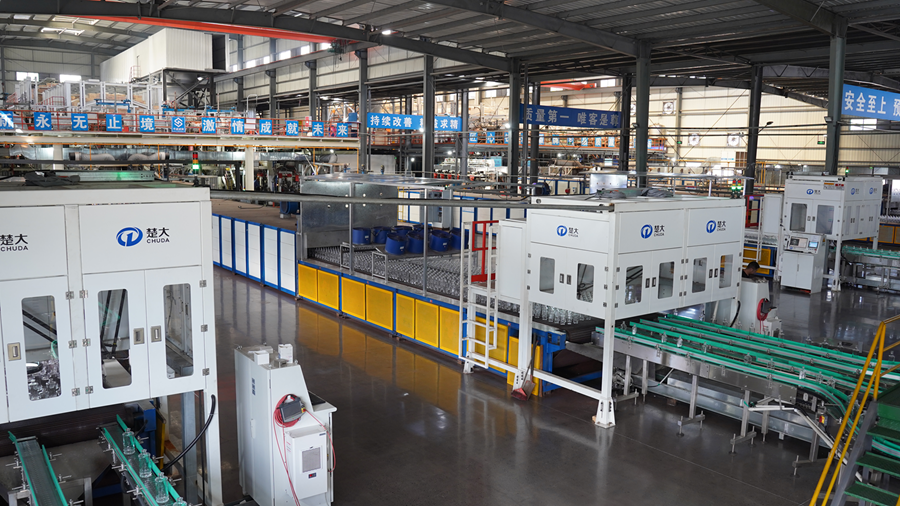 Modern intelligent glass container production lines widely adopt multi-weight molding, multi-cavity forming and AI visual inspection.